WAIC 2026 | Huazhe Xu of PokeBot
When Generalization Becomes Consensus General-Purpose Robots Step into Reality
July 21st, 2026
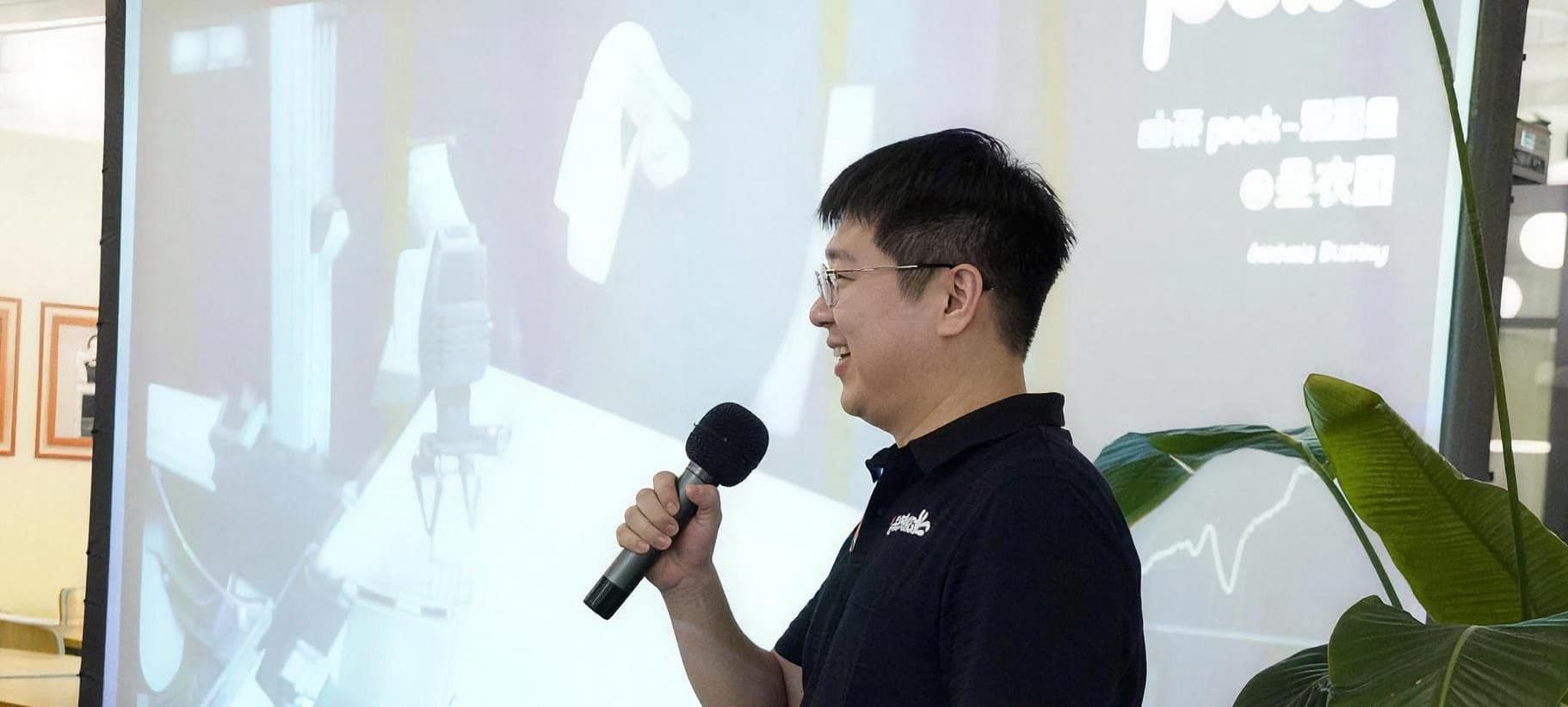
The World Artificial Intelligence Conference (WAIC 2026) was held in Shanghai from July 17 to 20. Huazhe Xu, founder of PokeBot, was invited to participate in a series of key events across the summit. Concurrently, PokeBot entered into a formal strategic partnership with the Shanghai Qi Zhi Institute (SQZ) and moved into the SQZ AI Venture Center. Leveraging the Institute’s world-class scientific research in quantum computing, robotics, and related frontiers, the Center serves as a dual-engine platform designed to incubate fundamental 0-to-1 innovations while accelerating 1-to-N industrial scale-up. On July 18, as one of the inaugural nine cohort teams, PokeBot founder Huazhe Xu joined Academician Andrew Chi-Chih Yao, President of the Shanghai Qi Zhi Institute, along with other enterprise representatives, in the official push-rod launch ceremony. From the incubation ground of foundational scientific research to the industrial validation of municipal-level strategic initiatives, this trajectory charts PokeBot’s clear path forward: anchored in long-term academic and scientific rigor, persistently breaking through core frontiers in general-purpose robotics, and bridging these capabilities into authentic real-world environments and industrial deployment. Throughout the summit, PokeBot founder Huazhe Xu was invited to speak across multiple key forums and panels. Addressing the "Embodied GPT Moment," technological pathways for general-purpose manipulation, and the evolving industrial ecosystem, he articulated his strategic vision for the future of general-purpose home robotics.
The essence of data scaling lies first in precisely measuring data distribution.
During a keynote dialogue hosted by Kunlun Tech, Huazhe Xu asserted that the "GPT Moment" for embodied AI cannot be judged by an impressive, one-off demonstration in an idealized laboratory setting. The true watershed milestone arrives only when a model—once out of its creators' hands—can be deployed across different countries, distinct users, and diverse robotic embodiments, reliably executing real-world tasks driven purely by natural language interaction. This capability first manifests as zero-shot generalization: when placed in an unfamiliar environment, the robot completes tasks immediately without the need for additional data collection or retraining. At the same time, true generality must encompass few-shot adaptation: when confronted with highly specialized or complex long-tail scenarios, the robot can master a completely new skill from merely ten to thirty minutes of human demonstration. Reaching this milestone, however, is not about mindlessly accumulating data. Huazhe Xu contends that prior to scaling data, the priority must be establishing rigorous metrics to quantify data distributions—determining precisely how much novel, incremental information each new task, object, and physical scene actually introduces. Only by spanning an adequately rich distribution of the real world can a robot cultivate true, generalizable physical capability.
Where you need the robot to perform is where your data distribution must go
During an embodied AI roundtable hosted by The Paper Tech, Huazhe Xu further articulated PokeBot’s strategic roadmap for domestic robotics. In his view, the home is far from a trivial downstream extension of mature industrial automation; rather, it represents an entirely independent physical domain governed by its own unique data distributions, task structures, and safety imperatives. He drew an analogy between the home and a low-velocity, highly generalized industrial environment. Here, the robot is no longer bound to rigid workstations and standardized parts, but must interact with intrinsically unstructured, deformable objects—such as clothing, tableware, and toys. Beyond raw task completion, the system must inherently account for compliant control, fault recovery, human-in-the-loop takeover, physical safety, and data privacy. Consequently, committing to domestic robotics demands an uncompromising foundation from day one: gathering data natively in home spaces, training models directly on domestic distributions, and architecting an end-to-end operational closed loop. Addressing the industry's competitive landscape, Huazhe Xu maintained that at this nascent stage, drawing battle lines against perceived rivals is premature; the singular priority must be collective effort—making robots truly work, and work exceptionally well. Teams across the ecosystem can forge meaningful collaborations in domains like physical data acquisition to expand the aggregate pie of the entire field. Destructive zero-sum friction only takes hold when technology fails to transition into reality, leaving players to squabble over stagnant, scarce resources. Once robots unlock genuine, transformative value across domestic and industrial services, competition naturally evolves into a virtuous race within an expanding, positive-sum frontier.
Physical AGI, in plain terms, simply means general-purpose labor
“While Physical AGI may sound grand and abstract, its real-world manifestation simply means enabling robots to perform genuine, universal labor anywhere,” Huazhe Xu noted during his address at the Physical World Intelligence Science Forum, co-hosted by Tsinghua University and the Shanghai Qi Zhi Institute. He defined the ultimate north star of embodied AI as achieving universal manipulation across arbitrary environments, arbitrary tasks, arbitrary objects, and arbitrary physical states. Realizing this ambition cannot rely on model scale alone; it demands an end-to-end engineering discipline spanning hardware, sensors, physical comprehension, motion optimization, and system control. Huazhe Xu categorizes this challenge into two mutually coupled technical axes: "dexterity" and "generalization." A robot must not only master fine-grained, intricate manipulation, but also adapt dynamically across varied objects, lighting conditions, backgrounds, spatial layouts, and tasks—all while delivering high success rates and execution speed. It is not merely about whether a robot can perform an action once, but whether it can sustain reliable, repeatable execution over long horizons at the operational throughput demanded by authentic service environments. The Mapo Tofu demonstration showcased by PokeBot serves as a comprehensive validation of this unified technological paradigm. The robot must seamlessly execute a long-horizon sequence of intricate sub-tasks—from slicing fragile tofu and heating the pan with oil to stir-frying and plating the finished dish—all while actively withstanding human-induced perturbations across ambient lighting, workflow variations, and spatial displacements. “Mapo Tofu is merely the beginning,” Huazhe Xu reflected. PokeBot’s ultimate ambition is to progressively transition an expanding spectrum of domestic tasks into real-world reality, truly bringing general-purpose robots into millions of homes. WAIC 2026 documented the accelerating evolution of embodied AI, offering the public a tangible glimpse into the world of tomorrow. As Huazhe Xu reflected in an interview: “The discussions across forums have deepened remarkably. Just two years ago, we still had to popularize what ‘generalization’ even meant; today, that consensus is already assumed.”
When generalization ceases to be a concept that demands constant explanation, the competition in embodied AI inevitably enters its next era: shifting from merely proving that robots require general-purpose capabilities, to rigorously answering how to achieve them through data distributions, foundation models, and full-stack systems engineering. Looking ahead, PokeBot will firmly adhere to its home-centric technical roadmap—continuously reinforcing its capabilities across data distributions, foundation models, and system-level architectures—to fulfill the enduring vision of bringing general-purpose robots out of the laboratory and into millions of households.